
VRF vs split systems: which is right for your office or shop?
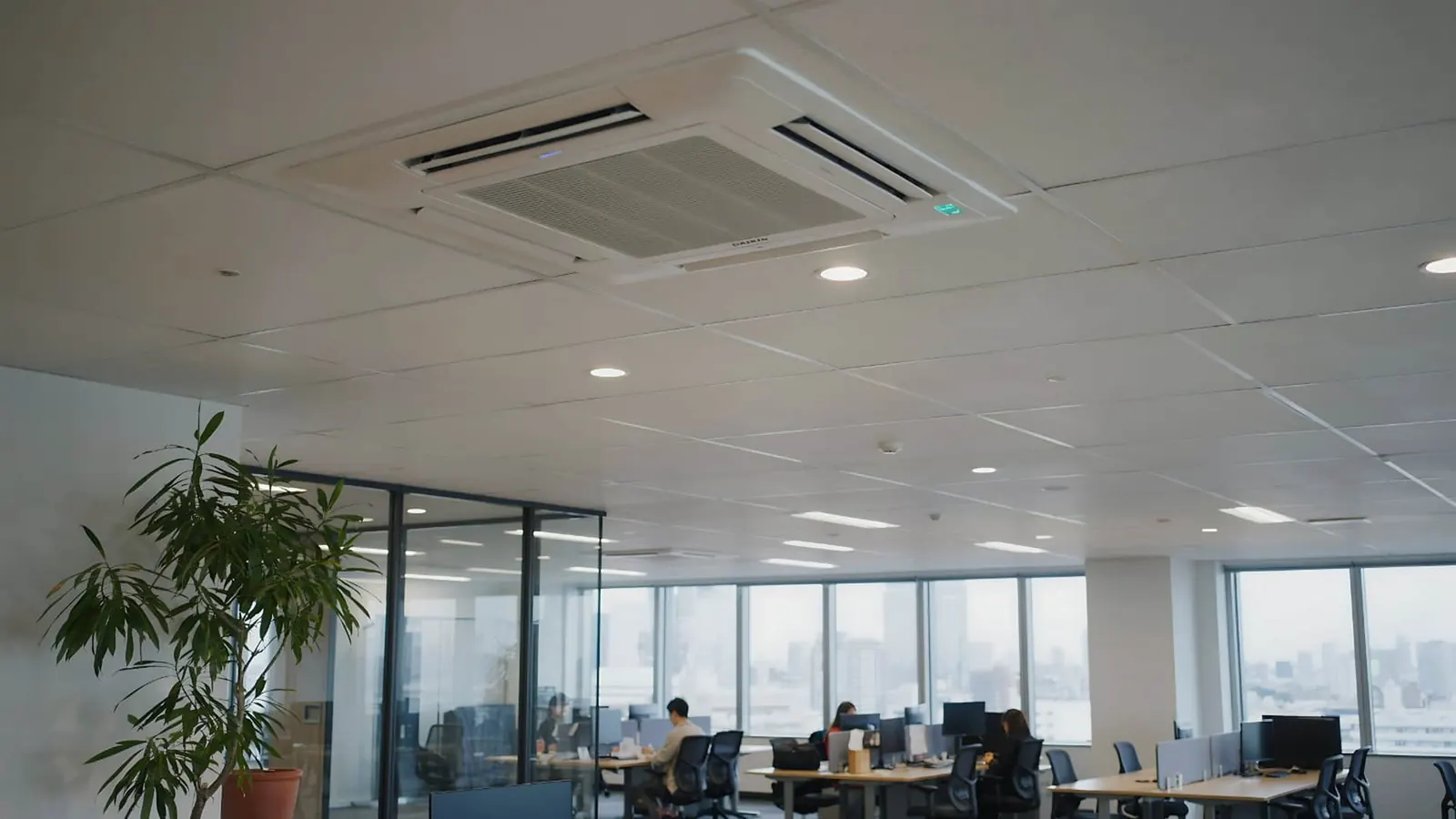
If you are cooling or heating one or two rooms, a split system is usually the simpler, cheaper answer. If you have many rooms or a whole floor to control, want one central controller, or need some areas heating while others cool, VRF (Daikin calls it VRV) is usually the better fit. The right answer comes from a survey, not a rule of thumb.
Here is where each option earns its place, and where it falls short.
The four options in plain English
Single split. One indoor unit connected to one outdoor unit. Simple, quick to install and easy to maintain. It suits a small shop, a single office, a meeting room or a server cupboard.
Multi-split. Several indoor units (typically two to five) running from one outdoor unit. It saves wall space outside, because you have one outdoor unit instead of several. The catch: all the indoor units on one outdoor unit either heat or cool at the same time, and if the outdoor unit stops, every room on it stops.
VRF / VRV (heat pump). VRF stands for variable refrigerant flow; Daikin’s name for its own version is VRV, variable refrigerant volume. One outdoor unit (or a bank of them) serves many indoor units across a building, and the system varies how much refrigerant goes to each one. Like a multi-split, a heat pump VRF system is either heating or cooling at any one time.
Heat recovery VRF. The same idea, but using a three-pipe design so different zones can heat and cool at the same time. Heat taken out of a room that needs cooling is moved to a room that needs heating, rather than dumped outside. Daikin’s VRV 5 Heat Recovery range is built around this.
Side-by-side
| Single split | Multi-split | VRF (heat pump) | Heat recovery VRF | |
|---|---|---|---|---|
| Typical use | 1 room | 2–5 rooms | Many zones, whole floors | Many zones with mixed demand |
| Outdoor units | One per room | One for several rooms | One or a bank for the building | One or a bank for the building |
| Heat and cool at the same time? | Each room independent | No, all rooms same mode | No, all zones same mode | Yes |
| Central control | Per unit | Limited | Yes | Yes |
| If the outdoor unit fails | One room affected | All rooms on it affected | Depends on design | Depends on design |
| Price | Quoted after survey | Quoted after survey | Quoted after survey | Quoted after survey |
Which fits your building?
A single shop unit or small office
One or two rooms: a single split (or two) is almost always right, and if one unit needs attention the rest of the business carries on. Our air conditioning page covers the systems we fit most often.
A handful of rooms
Three to five offices along a corridor, where they all want roughly the same thing at the same time, is multi-split territory. You get one outdoor unit rather than a row of them, which matters if outdoor space, landlord rules or neighbours are an issue. The largest outdoor units in Daikin’s multi-split range serve up to five rooms.
The honest drawback: if a south-facing office is roasting while the one on the north side is cold, a multi-split cannot heat one and cool the other.
A whole floor, a whole building, or multiple tenants
Once you are into lots of zones, long pipe runs, several floors, or you need one central controller and scheduling across the building, VRF is designed for the job. Daikin’s VRV 5 range covers large capacities, and bigger buildings use several outdoor units working together.
When you need heating and cooling at the same time
This is where heat recovery VRF earns its keep. Common examples:
- Offices with glass on one side and a cold, shaded side on the other
- A building with a busy server or comms room that needs cooling all year, next to offices that need heating in winter
- Spring and autumn in Scotland, when mornings are cold and afternoons get warm in sunny rooms
How much the recovered heat is worth depends on how your building is used, so we will not quote a percentage without looking at it.
Refrigerant, F-gas and why system size matters
A single split holds a small refrigerant charge. A large VRF system holds a lot more, because refrigerant runs through pipework across the whole building. Under the F-gas rules, the leak-checking duties on the operator (usually you, as the business) depend on the charge measured in tonnes of CO2 equivalent. NetRegs, the environmental guidance service for Scotland and Northern Ireland, sets out the intervals:
| Charge (tonnes CO2e) | Leak check interval | With a leak detection system |
|---|---|---|
| Under 5 | Not required | — |
| 5 to under 50 | Every 12 months | Every 24 months |
| 50 to under 500 | Every 6 months | Every 12 months |
| 500 and over | Every 3 months | Every 6 months (leak detection mandatory) |
The CO2e figure is the refrigerant weight multiplied by its global warming potential (GWP). R-32, used in current Daikin splits and the VRV 5 range, has a GWP of 675 under the F-gas regulation, so 5 tonnes CO2e is roughly 7.4 kg of R-32. Older R-410A systems (a 50/50 blend with a GWP of about 2,088) cross that line at roughly 2.4 kg. In short, most small splits sit below the threshold, and most VRF systems do not.
Other points worth knowing:
- Operators must keep refrigerant and leak-check records for at least five years.
- Only certified technicians, working for a certified company, can install, service or leak-check these systems. We are REFCOM certified.
- NetRegs notes that from 1 January 2025 new single-split systems holding less than 3 kg of refrigerant with a GWP of 750 or more can no longer be placed on the market, which is one reason the market has moved to R-32.
- Larger charges in small occupied rooms bring extra safety design requirements, which we check room by room at survey.
Maintenance: what each option asks of you
Every system needs servicing to keep running efficiently and to meet the F-gas duties above. The difference is scale.
Splits and multi-splits are straightforward: filters, coils, drains, refrigerant checks and controls. A fault usually affects one room or one group.
VRF is a building system: outdoor units, every indoor unit, branch boxes, controls and the leak-check schedule. Neglected, one fault can affect much of the building.
For commercial clients we provide planned maintenance and 24/7 support, and we service systems we did not install. See our commercial air conditioning and maintenance and servicing pages.
Do not forget fresh air
Neither splits nor VRF bring in fresh air; they heat and cool the air already in the room. Offices and shops still need proper ventilation, ideally designed alongside the air conditioning. Our ventilation services cover this.
Why a design-led survey comes first
Commercial systems are always quoted after a survey, because the answer depends on details a floor plan will not show:
- How many zones you actually need, and how each one is used through the day
- Heat from people, lighting, IT and sun
- Whether any areas need heating and cooling at the same time
- Where the outdoor units can go, and any landlord or planning constraints
- Pipe routes, ceiling voids and maintenance access
- Refrigerant charge, F-gas duties and room-by-room safety checks
From that we recommend the simplest system that does the job. Sometimes that is VRF. Quite often it is a couple of well-placed splits. We will tell you which, and why. More on how we approach larger projects on our commercial HVAC design and installation page and our commercial air conditioning service.
Frequently asked questions
Is VRF the same as VRV?+
Yes, in practice. VRF (variable refrigerant flow) is the general industry term. VRV (variable refrigerant volume) is Daikin’s name for its own range. When people say “a VRV system” they usually mean a Daikin VRF system. We install Daikin first, and can source other brands where a project calls for it.
Can a split system heat as well as cool?+
Yes. Modern split and multi-split systems are reversible heat pumps, so the same unit heats in winter and cools in summer. The limit with a multi-split is that every indoor unit on the same outdoor unit has to be in the same mode, so you cannot heat one room while cooling the next.
When is heat recovery VRF worth considering?+
When parts of your building regularly need cooling while other parts need heating: glazed south-facing offices beside shaded ones, server rooms beside open-plan space, or shop floors beside stockrooms. If every zone always wants the same thing, a standard heat pump VRF or split systems may do the job for less.
Do I need to leak-check my air conditioning?+
It depends on the refrigerant charge in tonnes of CO2 equivalent. Systems under 5 tonnes CO2e have no mandatory leak-check interval; above that, checks run from every 12 months down to every 3 months for very large systems. Most small splits fall below the threshold, while most VRF systems do not. We can tell you where yours sits.
Get a straight answer
Tell us about your building and how it is used, and we will recommend the simplest system that works, whether that is VRF or a couple of splits. Commercial systems are quoted after a free design-led survey. Call 01506 894600 or get in touch.
Sources
- NetRegs — Stationary refrigeration, air conditioning and heat pumps: F-gas controls — https://www.netregs.org.uk/environmental-topics/air-pollution/fluorinated-gases-f-gases/stationary-refrigeration-air-conditioning-and-heat-pumps-f-gas-controls/
- Regulation (EU) No 517/2014 (retained), Annex I — GWP of HFC-32 (675) and HFC-125 (3,500) — https://www.legislation.gov.uk/eur/2014/517/annex/I
- Checking F gas equipment for leaks (GOV.UK, updated Aug 2026) — https://www.gov.uk/guidance/checking-f-gas-equipment-for-leaks
- Daikin UK — VRV 5 heat recovery — https://www.daikin.co.uk/en_gb/product-group/vrv/vrv-5-heat-recovery.html