
Solar Panels and Battery Storage in Scotland
Part of our series: Solar Panels in Scotland: Everything You Need to Think About Before Installation
Most homeowners asking about solar panels in Scotland eventually ask the same follow-up question: should I add a battery? It is a reasonable thing to wonder. The technology has matured quickly, prices have come down, and the marketing around battery storage has become louder. But the honest answer is still: it depends — and getting it wrong in either direction can cost money.
This guide sets out how battery storage works alongside solar, what it actually costs in Scotland in 2026, how to size a system correctly, and when adding a battery makes financial sense and when it does not.
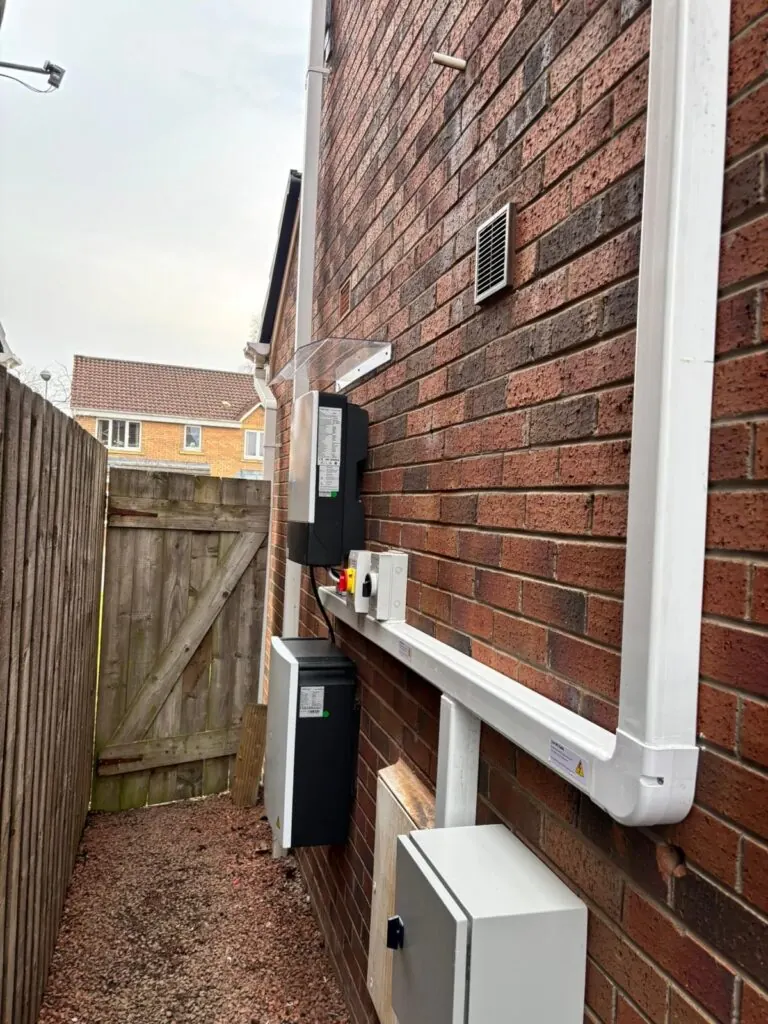
Solar and Battery install
How battery storage works with solar
Solar panels generate electricity when daylight is available. The problem is that peak generation — roughly 10am to 3pm — does not always match peak household demand, which typically falls in the morning before work and in the evening. Without a battery, surplus electricity is exported to the grid, usually at a lower rate than you would pay to import it.
A home battery stores that surplus generation so it can be used when the panels are not producing. In practical terms, this means your own solar electricity powers your lights, appliances, and heating in the evening rather than electricity bought from your supplier. The battery sits between the solar inverter and your consumer unit. When the panels are generating more than the household is using, the excess charges the battery. When demand outstrips generation — in the evening, on overcast days, or in winter — the battery discharges first before the home draws from the grid.
There are two main system types: AC-coupled and DC-coupled. If you are adding a battery to an existing solar installation, the battery will usually be AC-coupled, meaning it connects to your home’s existing AC circuits rather than directly to the panels. If you are installing solar and battery together from scratch, a DC-coupled or hybrid inverter system can be slightly more efficient. Your installer should explain which approach they are recommending and why.
Do you actually need a battery?
The marketing case for battery storage is straightforward: store your solar energy, use it later, reduce your bills. The financial case is more nuanced. A battery adds cost and complexity, and payback periods are usually longer than for panels alone. That means a battery tends to make most financial sense when the system is properly matched to the home.
A battery usually makes the most sense when:
- You have a good-sized solar system, typically 4kWp or more, generating meaningful daily surplus in summer.
- Your household’s evening and overnight electricity demand is relatively high.
- You are on, or willing to move to, a time-of-use tariff that rewards flexible usage.
- You are co-installing solar and battery together, which can reduce total installation cost.
A battery makes less sense when:
- Your solar system is small, 3kWp or under, and generates little surplus.
- Most of your electricity use happens during the day, so you already self-consume most of your generation.
- You are on a flat-rate electricity tariff with no real peak and off-peak difference.
There is also a non-financial reason some households add a battery: resilience. A battery system with backup functionality can keep essential circuits running during a power cut. Not all batteries include this, so it needs to be specified at the design stage.
How to size a battery for a Scottish home
Battery capacity is measured in kilowatt-hours, or kWh. The principle for sizing is straightforward: the battery should be large enough to cover your evening electricity demand from surplus solar generated that day, but not so large that it sits mostly empty and weakens the payback.
In Scottish conditions, this involves a seasonal trade-off. A typical 4kWp south-facing system in Central Scotland can generate a useful surplus in summer, but much less in winter. An average Scottish household uses around 10 to 14 kWh per day, while evening demand from sunset to bedtime is often about 3 to 6 kWh. That is why a 9.5 to 10 kWh battery is often a practical choice for many homes.
That said, the right size depends on your specific consumption profile and roof orientation. A properly scoped system from a qualified installer should include a generation estimate and a self-consumption model. If your quote does not include these, ask for them before you decide.

Closeup white calculator and pink piggy bank on modern black photovoltaic solar panel
What does battery storage cost in Scotland in 2026?
Battery storage prices have fallen significantly in recent years, but the final cost still depends on battery size, installer, system design, and whether the battery is being added to an existing installation or fitted alongside new solar panels.
As a general guide, typical installed costs for a domestic battery in Scotland are:
- Small battery, 5 to 6 kWh: £4,500 to £6,000 installed
- Mid-size battery, 9.5 to 10 kWh: £6,500 to £9,000 installed
- Large battery, 13 to 14 kWh: £8,500 to £12,000 installed
Domestic battery storage is currently zero-rated for VAT until 31 March 2027, so this is a useful time to compare quotes if you are planning an installation. For a full picture of solar and battery costs together, see our guide to how much solar panels cost in Scotland.
Home Energy Scotland also offers grant and loan support for eligible homes, so it is worth checking the latest scheme rules before assuming you will be paying full price. A written offer must usually be in place before installation begins.
Is battery storage worth it in Scotland?
This question is worth answering carefully, because the honest answer is not the same for every household. For a home with a well-sized solar system and reasonable evening demand, a battery can add a meaningful amount of extra savings on top of what the solar panels alone deliver. For homes in that position, battery storage often improves self-consumption enough to make the system feel much more complete.
For a household with a smaller system or mostly daytime usage, the additional savings can be modest and the payback period can stretch beyond what most homeowners consider worthwhile. That does not automatically make the battery a bad choice, but it does mean the decision is being driven more by convenience, resilience, or future flexibility than by pure economics.
Battery technology is also improving steadily. Lithium iron phosphate, or LFP, is widely used in domestic storage systems, and many batteries now offer long cycle lives and strong warranties. Degradation over time is real, but it is usually gradual, which is one reason batteries can still make sense even when the payback is not immediate.
Smart tariffs and grid charging
One of the less-discussed advantages of a home battery is the ability to charge it cheaply from the grid overnight and discharge it during peak-rate periods, even on days when solar generation is low. This is known as grid charging or grid arbitrage, and in Scotland’s winter months, when solar production is limited, it can make a noticeable difference to the economics.
Time-of-use tariffs, such as Octopus Go and Intelligent Octopus Go, offer off-peak electricity at lower rates than standard daytime pricing. Charging a battery overnight and using that stored power later in the day can create extra savings beyond what solar alone provides. This is worth asking about at the specification stage, because not all batteries and inverters support smart tariff integration equally well.
Can you retrofit a battery to an existing solar system?
Yes — and it is one of the more common requests. If you had solar panels installed in the last five to ten years, adding a battery retrofit is often straightforward. An AC-coupled battery connects to your home’s existing circuits rather than directly to the panels, so compatibility with the original solar setup is rarely a major issue.
The installation typically takes less than a day and does not usually require changes to the solar array itself. There are still a few things to check before proceeding. Your consumer unit may need upgrading if it is old or has limited spare capacity, your installer should handle the correct DNO notification route, and your home insurer may need the addition noted on the policy. If you previously received Feed-in Tariff payments, it is worth checking that the retrofit does not affect those payments.
Choosing a battery brands Thermal Care works with
Thermal Care works with a carefully selected range of battery and inverter brands that we trust for Scottish conditions and long-term support. What matters most is not just the brand name, but whether the system is correctly specified for the property and the household’s usage pattern.
EcoFlow is one of the battery brands we use for domestic installations where flexibility, smart controls, and ease of use are important. The system range is well suited to homeowners who want reliable storage, straightforward monitoring, and a modern app-based experience.
FoxESS is another brand we work with for solar-plus-storage installations where performance, value, and compatibility are key considerations. Its hardware is widely used across the domestic market and is a strong option when the system needs to be tailored to the property and the customer’s energy usage.
Where a customer has a specific preference for another brand, we discuss compatibility and suitability as part of the design process. What matters most is making sure the battery, inverter, and installation are all matched properly to the home rather than choosing a system based on brand name alone.
! Thermal Care Vans at Solar and Battery install
Thermal Care Vans at Solar and Battery install
What to ask your installer
Whether you are getting quotes for solar and battery together or considering a retrofit, these are the questions worth asking:
- What battery capacity are you recommending, and why?
- Is the battery AC-coupled or DC-coupled, and what does that mean for my setup?
- Does the system support backup power in the event of a grid outage?
- Which smart tariffs is this battery compatible with?
- How do you handle DNO notification and grid connection paperwork?
- Is your installation MCS certified?
- What does the monitoring setup look like, and what app will I use?
An installer who cannot answer these questions clearly, or who recommends a battery without showing you the underlying generation and consumption assumptions, is worth being cautious about.
Your next steps
Battery storage is worth serious consideration for many Scottish homeowners going solar, but only when it is correctly sized for the home and the household’s usage. At Thermal Care, we design every system from scratch based on your roof, your consumption data, and your goals.
We are MCS-accredited solar installers based in Bathgate, covering homes across Central Scotland. If you are thinking about whether battery storage makes sense for your property, the next step is to talk through the system design before making a decision, Conact us.