
Contents
If you're researching best solar panels for scotland, you've probably already worked out that solar makes financial sense in Scotland. Payback periods are realistic, energy bills are high, and the technology has matured significantly in recent years.
But knowing solar works and knowing which panels to choose are two very different things. Walk into a conversation with three different installers and you'll likely hear three different recommendations — and not always for the right reasons.
This guide cuts through the noise. We've written it specifically for Scottish homeowners, taking into account our climate, our roof types, and the planning quirks that don't apply south of the border. By the end, you'll know exactly what to look for — and what questions to ask.
What Makes a Solar Panel the Best Choice for a Scottish Home
Scotland's climate is different from the rest of the UK, and that difference matters when you're choosing solar panels. We have shorter daylight hours in winter, more overcast days year-round, and a higher proportion of diffuse light — the kind that comes through cloud cover rather than direct sunshine.
This doesn't mean solar panels don't work here. It means the panels you choose need to perform well in those conditions, not just on a clear June afternoon.
When evaluating which panels are best suited to Scottish homes, these are the criteria that actually matter:
- Real-world efficiency in low-light and overcast conditions — how the panel performs on a typical grey Scottish day, not just in ideal test conditions
- Reliability and warranty length — a longer product and performance warranty reflects manufacturer confidence in the panel's durability
- Aesthetics on visible or street-facing roofs — particularly relevant if you live in a conservation area, a tenement, or a traditional sandstone terrace
- Brand quality and installer support — well-established manufacturers with a strong UK supply chain make it easier to honour warranties and source replacements
- Lifetime value for money — the cheapest panel on day one is rarely the best value over 25 years
Types of Solar Panels — And Which We Recommend for Scotland
There are three main types of solar panel technology on the market. Not all of them are equally suited to Scottish homes — and being clear about that upfront will save you a lot of time when comparing quotes.
Monocrystalline Panels — The Modern Standard
Monocrystalline panels are made from a single crystal structure of silicon, which gives them a higher purity and, as a result, higher efficiency than other panel types. In plain terms, they generate more electricity from the same amount of roof space.
For Scottish homes — where roof space is often limited and light levels are frequently low — this matters a great deal. A higher-efficiency panel produces more on an overcast February afternoon than a lower-efficiency alternative of the same physical size.
Modern monocrystalline panels also perform well in diffuse light conditions, handle temperature variation better than older technologies, and are available in all-black finishes that suit a wide range of Scottish roof aesthetics. They are the panel type we install as standard at Thermal Care Scotland, and the reason is straightforward: for most Scottish homes, they simply offer the best combination of output, reliability, and appearance.
Polycrystalline Panels — The Older Generation
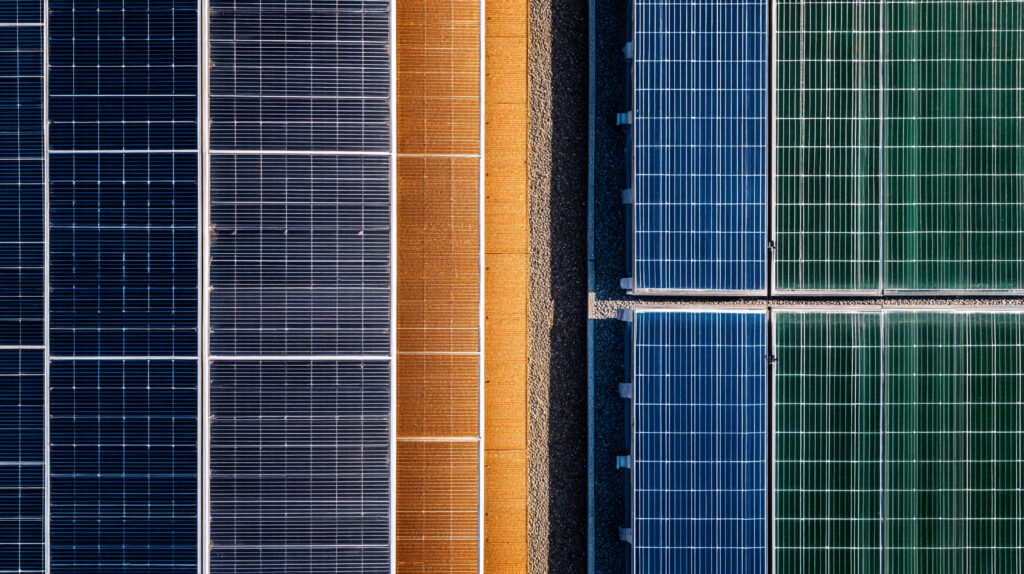
Polycrystalline panels were the industry standard for many years and are still in use on homes installed before roughly 2018–2020. They're made from multiple silicon fragments fused together, which gives them their distinctive blue, speckled appearance and makes them slightly less efficient than monocrystalline alternatives.
On paper, they're cheaper per panel. In practice, that saving is often offset by needing more panels to achieve the same output — which means more roof space and a less aesthetically pleasing result. On a typical Scottish semi-detached with a modest south-facing roof, getting the most out of every square metre matters.
We rarely recommend polycrystalline panels for new domestic installations in Scotland today. The efficiency and aesthetic advantages of monocrystalline have made them the clear choice for the vast majority of homes.
What About Thin-Film and Other Panel Types?
Thin-film panels use a completely different manufacturing process and are most commonly found on large commercial or industrial rooftops. They're flexible, lightweight, and can be applied to unusual surfaces — but their lower efficiency makes them impractical for typical domestic roofs where space is the primary constraint. For most Scottish homeowners reading this guide, thin-film isn't relevant.
Why Monocrystalline Is Usually the Best Solar Panel for Scotland
To bring this together clearly:
- Monocrystalline panels generate more electricity per square metre — critical on Scotland's often modest roof sizes
- They perform better in low-light and overcast conditions than older panel technologies
- They offer a cleaner, more discreet appearance — available in all-black for conservation areas and traditional properties
- Their longer track record of reliability gives manufacturers confidence to back them with strong warranties
- They represent better lifetime value, even if the upfront cost is marginally higher than budget alternatives

Key Specs to Look For — Without the Jargon
When you're comparing quotes or researching panels online, you'll encounter a range of technical terms. Here's what actually matters, explained plainly.
Efficiency Rating
A panel's efficiency rating tells you what percentage of available sunlight it converts into usable electricity. Standard monocrystalline panels typically sit in the 20–22% range, with premium models reaching 22–24%.
In practical terms, a 22% efficient panel will generate noticeably more electricity than a 19% panel of the same physical size. On a small Scottish roof, that difference adds up over a year — and over 25 years, it's significant.
Low-Light Performance and Cell Technology
This is one of the most important specs for Scottish homeowners and one of the least discussed in generic UK solar guides. Not all monocrystalline panels are the same — the cell technology inside them makes a real difference to how they perform on overcast days.
The two technologies worth knowing about are TOPCon (Tunnel Oxide Passivated Contact) and IBC (Interdigitated Back Contact). Both are types of N-type cell technology, and both offer measurably better performance in low-light conditions compared to older PERC-based panels. When comparing quotes, asking whether a panel uses N-type cell technology is a straightforward way to identify panels that are well-suited to Scottish conditions.
Brands like Astronergy, JA Solar, Canadian Solar, and DMEGC all produce N-type monocrystalline panels in their premium ranges — and these are the types of panels worth prioritising if low-light performance is a key concern for your roof.
Warranty — Product vs Performance
Solar panel warranties come in two parts, and it's worth understanding both.
The product warranty covers the physical panel against manufacturing defects — typically 12 to 25 years depending on the manufacturer. The performance warranty guarantees that the panel will still be generating a minimum percentage of its original output after a set number of years. A good performance warranty will guarantee at least 80–85% output after 25 years, with a low annual degradation rate of around 0.4–0.5%.
When comparing quotes, ask for both figures. A longer product warranty and a low degradation rate are indicators of a manufacturer confident in the quality of what they're selling.
Temperature Coefficient
This is a secondary spec, but worth a mention in a Scottish context. The temperature coefficient tells you how much a panel's output drops as temperature increases. Scotland's cooler climate actually works in your favour here — panels operate more efficiently in moderate temperatures than in intense heat. Panels with a low temperature coefficient (closer to -0.25%/°C rather than -0.40%/°C) will perform slightly better across our climate's range of conditions.
Aesthetics
For many Scottish homeowners — particularly those in conservation areas, on tenements, or in traditional stone-built streets — how the panels look on the roof is a genuine consideration and not a vanity one. Some local planning guidance requires that panels don't significantly alter the character of a streetscape.
All-black monocrystalline panels, where both the cells and the frame are black, sit more discreetly on dark Scottish slate roofs than silver-framed alternatives. If aesthetics or planning are a factor for your property, it's worth specifying all-black panels from the outset rather than retrofitting the conversation later.
Best Solar Panel Options for Scottish Homes in 2026
Rather than recommending specific models that may change with manufacturer product cycles, we find it more useful to match panel types to situations. Here's how to think about it.
Best for Small or Heavily Shaded Roofs
If your usable roof space is limited — fewer than 20 square metres of south or south-west facing area — or if part of your roof is shaded by a chimney stack, neighbouring building, or trees for part of the day, you need the best low-light solar panels you can get.
In this scenario, prioritise premium N-type monocrystalline panels with an efficiency rating of 22% or above. Panels using TOPCon or IBC cell technology will recover more energy during partial shading and overcast conditions. Ask your installer about microinverters or power optimisers too — these can recover additional output that a standard string inverter would otherwise lose to shading.
The upfront cost is higher, but on a small or compromised roof the performance difference justifies it.
Best for Larger Roofs on a Realistic Budget
If you have a generous south-facing roof — 25 square metres or more — you have more flexibility. A good-quality mid-range monocrystalline panel in the 20–22% efficiency range will serve you well without the premium price tag of the very highest-efficiency options.
Look for panels from established manufacturers with a 25-year performance warranty and a degradation rate below 0.5% per year. Brands like JA Solar and Canadian Solar offer well-regarded panels at this level — reliable, well-warranted, and proven in UK conditions.
Best for Visible, Conservation Area, or Tenement Roofs
If your roof is street-facing, you're in a conservation area, or your property is a traditional tenement or listed building, aesthetics and planning compliance come first.
Specify all-black monocrystalline panels from the outset. DMEGC and Astronergy both offer all-black panels that perform well and present cleanly on traditional Scottish rooflines. Your installer should also confirm whether permitted development rights apply to your property — or whether a planning application will be required before work begins.
Scotland-Specific Factors That Affect Your Panel Choice
Generic UK solar guides rarely cover these. They matter here.
Roof Type and Ownership
Scotland has a higher proportion of tenement properties than almost anywhere else in the UK. If you own a flat in a tenement block, you may not own the roof — and even if you do, you may need consent from other owners or a factors' agreement before installation can proceed. It's worth clarifying this before you progress too far with quotes.
Townhouses and terraced properties with rear roofs often have north-facing aspects at the front and south-facing at the rear. An experienced installer will assess both and advise on the optimal configuration, which may include an east-west split across multiple roof planes.
Orientation and Shading Patterns
South-facing roofs at a pitch of around 30–35 degrees are optimal for Scotland. However, south-west and south-east orientations still perform well — typically within 10–15% of a true south installation — and are often perfectly viable.
What matters more than a few degrees of orientation is shading. Chimney stacks, dormer windows, neighbouring buildings, and mature trees can all create shading patterns that significantly reduce output if not properly assessed. A thorough site survey — ideally including a shading analysis — is something you should expect from any reputable installer.
Planning and Conservation Area Rules
In Scotland, most solar panel installations on domestic properties fall under permitted development, meaning you don't need planning permission. However, there are important exceptions. If your property is a listed building, sits within a conservation area, or faces a road, you may need to apply for planning consent before installation.
Scottish planning policy guidance on this is distinct from England and Wales, so it's worth checking with your local planning authority — or asking your installer to do so as part of the survey process.
System Size and Payback
How many panels you need and what payback period to expect are closely related questions. We've covered both in detail in our separate guides — see our solar panel system size guide and our solar panel payback period guide for Scotland for the full picture.

How to Compare Solar Quotes
A good quote tells you far more than just the total price. Here's a simple checklist of what to look for — and what to ask for if it isn't included.
- Panel make, model, and type — is it monocrystalline? N-type? What's the efficiency rating?
- Product warranty and performance warranty — how many years, and what's the guaranteed output at 25 years?
- Degradation rate — what percentage of output will the panel lose per year?
- Inverter or optimiser details — what brand, and why has the installer chosen it for your system?
- Estimated annual kWh output — based on your specific roof orientation, pitch, and location
- Projected bill savings — based on your current usage, not a generic assumption
- MCS certification — your installer must be MCS certified for you to access the Smart Export Guarantee (SEG) and for the installation to meet UK quality standards
One question worth asking every installer: "Can you show me a good, better, and best panel option for my roof?" A confident, knowledgeable installer will be able to walk you through the differences — all using monocrystalline — and explain why they're recommending what they're recommending. If they can only offer one option, or if they struggle to explain the differences, that tells you something.
When to Pay More — and When You Don't Need To
When Premium Panels Are Worth It
Paying for premium N-type monocrystalline panels makes most sense when:
- Your usable roof space is limited and you need to maximise output per square metre
- Your roof has shading challenges that lower-efficiency panels will struggle with
- This is a forever home and you want the best long-term return over 25+ years
- Aesthetics are important and you're specifying all-black panels for a conservation area or traditional property
In these situations, the higher upfront cost is typically recovered through better performance over the lifetime of the system.
When Mid-Range Monocrystalline Is the Right Call
If you have a large, unshaded south-facing roof, a tight budget, or you're likely to move within the next decade, a well-specified mid-range monocrystalline panel is an entirely sensible choice. You're still getting a reliable, efficient, warrantied product from a reputable manufacturer.
Don't let anyone tell you that mid-range means low quality — the right mid-range monocrystalline panel on the right roof will perform well for decades. What matters is that it's properly specified, correctly installed, and backed by an MCS-certified installer.
Frequently Asked Questions
Frequently Asked Questions
Yes — and more effectively than most people expect. Modern monocrystalline panels generate electricity from diffuse light, not just direct sunshine. Scotland receives enough annual irradiation to make solar a financially viable investment for most homes. Edinburgh, for example, receives around 1,100–1,200 kWh of solar irradiation per square metre per year — less than the south of England, but well within the range where solar delivers meaningful savings. Our guide on whether solar panels need direct sunlight goes into more detail on this.
Are monocrystalline panels worth the extra cost over polycrystalline?
For the vast majority of Scottish homes today, yes. The efficiency gap between monocrystalline and polycrystalline panels has widened significantly in recent years, while the price difference has narrowed. On a typical Scottish roof with limited south-facing space, a monocrystalline panel will generate meaningfully more electricity over its lifetime than a polycrystalline equivalent of the same physical size.
What's the difference between N-type and standard monocrystalline panels?
Standard monocrystalline panels use P-type PERC cell technology, which has been the industry standard for a number of years. N-type panels — including those using TOPCon and IBC cell technology — use a different silicon structure that gives them higher efficiency, better low-light performance, and lower degradation over time. For Scottish conditions, N-type panels offer a genuine performance advantage that becomes more pronounced on overcast days.
How many solar panels do I need for a Scottish home?
This depends on your roof size, energy consumption, and how much of your usage you want to offset. A typical three-bedroom Scottish home with annual consumption of around 3,500 kWh might need a 10–14 panel system, depending on panel efficiency and roof orientation. For a tailored calculation based on your specific home, see our solar panel system size guide
The Right Panel for Your Scottish Home
There's no single perfect solar panel — but there is a best fit for your roof, your budget, and your situation. For most Scottish homes, that means a quality monocrystalline panel, properly specified and professionally installed by an MCS-certified team.
At Thermal Care Scotland, we only install monocrystalline panels — and we'll always explain why we're recommending what we're recommending, in plain language, based on your specific property.
If you'd like a tailored recommendation, contact us today with your roof details and we'll advise on the right system for your home. You can also explore our full range of solar PV and battery services to see how we approach the whole system, not just the panels.
